
People Often Search For...
People Often Search For...

Welding technology continues to evolve, and laser welding is quickly becoming an option worth considering for shops looking to improve productivity, consistency, and efficiency.
Unlike traditional welding processes such as TIG and MIG, laser welding uses a highly concentrated beam of light to join metal. The result is a precise welding process with a smaller heat-affected zone, less distortion, and the potential to significantly reduce welding time.
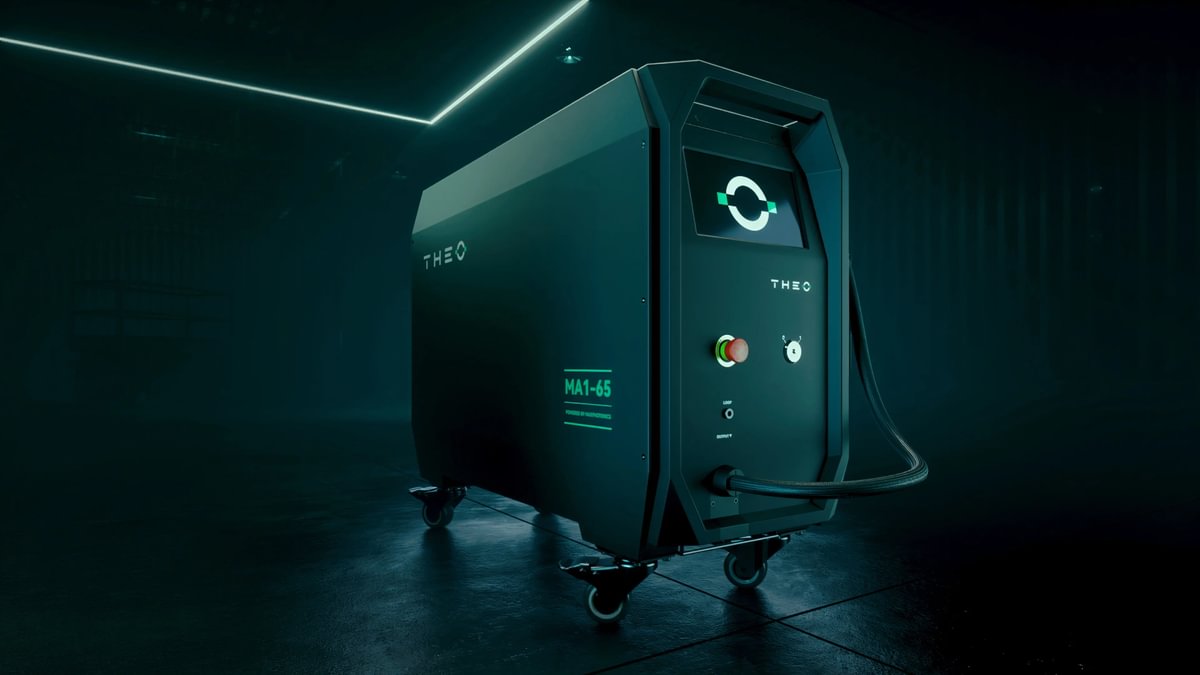
For fabricators looking for ways to do more without sacrificing quality, handheld laser welding offers an exciting new option. One machine making that technology more accessible is the THEO MA1 Laser Welding Machine.

Traditional welding methods have long been the standard for fabrication and manufacturing. But they can also require significant operator skill, multiple passes, substantial heat input, and post-weld cleanup.
Laser welding takes a different approach.
By concentrating energy into a small area, laser welding creates a focused melt pool that allows operators to make strong, consistent welds while putting less heat into the surrounding material. That can translate into less distortion, less rework, and a cleaner finished product.
Here are a few of the biggest advantages of laser welding:
For many applications, speed is one of the biggest advantages of laser welding. THEO reports that its laser welding technology can weld up to 10 times faster than TIG, depending on the application and material. Faster welding means more parts completed in less time—and greater productivity without necessarily adding labor. For busy fabrication shops, shaving time off each weld can add up quickly across an entire production schedule.
Heat is necessary for welding, but too much heat can create problems. Traditional welding processes can produce a larger heat-affected zone, increasing the potential for warping, distortion, and changes to the surrounding material. Laser welding’s concentrated energy and lower heat input can help minimize these effects. That makes laser welding particularly useful when working with thinner materials or applications where maintaining the shape and appearance of the finished part is important.
Laser welding can produce smooth, uniform weld seams with a deep and concentrated melt pool. That consistency can reduce the need for grinding, polishing, and other post-weld processing. Less cleanup means less time spent on work that doesn’t directly add value to the finished product. The result? A cleaner weld and a more efficient workflow.
Finding and training skilled welders is a challenge for many fabrication businesses. One of the advantages of handheld laser welding is that the process can be easier to learn than traditional welding methods. THEO designed the MA1 with a user-friendly interface and built-in settings intended to simplify operation across different materials and thicknesses. That doesn’t eliminate the importance of proper training or welding knowledge, but it can help operators become productive more quickly.
Efficiency isn’t just about how quickly a machine completes a weld. It’s also about how efficiently it uses energy. THEO reports that the MA1 can reduce electricity consumption by up to 80% compared with traditional welding technologies. Its fiber laser system is also air-cooled, meaning the machine doesn’t require an external chiller. For shops running equipment regularly, improved energy efficiency can contribute to meaningful long-term operating savings.
Like any industrial welding technology, laser welding requires the right safety practices. The THEO MA1 is a Class 4 laser product, so operation requires appropriate laser safety eyewear or a laser-rated welding helmet and a controlled work area designed to prevent unintended exposure. Proper training and adherence to the manufacturer’s safety requirements are essential before operating the equipment.
So, what does all of this look like in an actual machine? The THEO MA1 is a compact, handheld laser welding system designed to bring the advantages of laser welding into real-world fabrication environments.
The MA1 family includes several configurations to accommodate different applications:
The systems are designed to be portable, with the MA1-35 weighing approximately 62 pounds, the MA1-45 approximately 84 pounds, and the MA1-65 and MA1 Ultra approximately 86 pounds. The MA1 also features a lightweight welding torch designed to reduce operator fatigue, along with a built-in wobble function that can produce wider, smooth weld seams.
The MA1 is designed for a range of common fabrication materials, including:
Titanium and nickel alloys can be welded with the MA1, but these materials require appropriate gas shielding and welding techniques. If you’re interested in using the MA1 for these applications, let us advise you on the proper setup and technique for your specific material and application.
Laser welding isn’t necessarily about replacing every traditional welding process. Instead, it’s another tool that can help fabricators determine the best process for a particular application.
If your shop is looking for faster production, reduced distortion, less post-weld finishing, lower energy consumption, or a shorter operator learning curve, laser welding may be worth exploring.
And as the technology becomes more accessible, it’s becoming easier for shops of all sizes to see what laser welding can do.
At Atlas Welding Supply, we’re always looking for technology that can help our customers work smarter, improve productivity, and stay competitive.
The THEO MA1 is an exciting example of where welding technology is headed: faster, more efficient, precise, and designed with the operator in mind.
If you’re curious about whether laser welding makes sense for your operation, talk with the team at Atlas Welding Supply. We can help you explore the technology, understand your options, and determine whether a THEO MA1 could be a good fit for your welding applications.
Ready to see what laser welding can do? Contact Atlas Welding Supply to learn more about the THEO MA1.